- NEW PREPRINT! We systematically reviewed molecular epidemiology studies looking at strain discordance in pairs of people with TB disease and history of household contact We found 30 studies from 18 countries. Excluding 4 studies at high risk of bias, we had data on 1544 household case pairs [1/n]
- Strain discordance - using 24 loci MIRU-VNTR, RFLP or WGS - is COMMON! Around a third of household case pairs in low and medium incidence countries have different strains of Mycobacterium tuberculosis (Mtb) More than half of pairs in high incidence countries have different strains [2/n]Dec 20, 2025 13:51
- You can estimate the proportion of TB attributable to recent household transmission as Strain CONCORDANCE * proportion of people with TB with a history of exposure to a putative household index case As the latter proportion was not usually provided, we borrowed from external data (see link) [3/n]
- Using this approach, we estimated that a median of 10.3% of TB is attributable to recent household transmission (range 1.4% - 20.4%) This estimate is in keeping with estimates of this proportion using very different methods, e.g. this great modelling study by @jasonandrews.bsky.social [4/n]
- CAVEAT 1 Molecular epidemiology studies tend not to include young children However, there are some adult - child case pairs with typing data showing discordance is not infrequent, i.e. 7/19 pairs in Cape Town (see pubmed.ncbi.nlm.nih.gov/12757042/) See also this nice review by Leo Martinez [5/n]
- CAVEAT 2 Mtb has a slow molecular clock (approx 0.5 SNP per year) and people living in the same household will often have shared social contact networks Particularly in settings with limited strain diversity, molecular epidemiology studies will tend to overestimate household transmission [6/n]

- CAVEAT 3 Strain discordance does NOT necessarily mean discordance in drug susceptibility In settings with little drug resistance, most people will have DSTB regardless of strain type A useful review of DST in household case pairs has been recently published [7/n]
- Why does transmission outside the household play such a dominant role in TB epidemiology My favoured explanation is that infectiousness is highly heterogenous and people have many more community than household contacts Nicky McCreesh and @richardwhite321.bsky.social have modelled this [8/n]
- INTERESTING IDEA TB clusters in households so, if lots of this is NOT household transmission, it must be determinants of susceptibility clustering in households - recent migration, shared contact networks, malnutrition etc This excess risk will persist after contact tracing/IPT is finished [9/n]
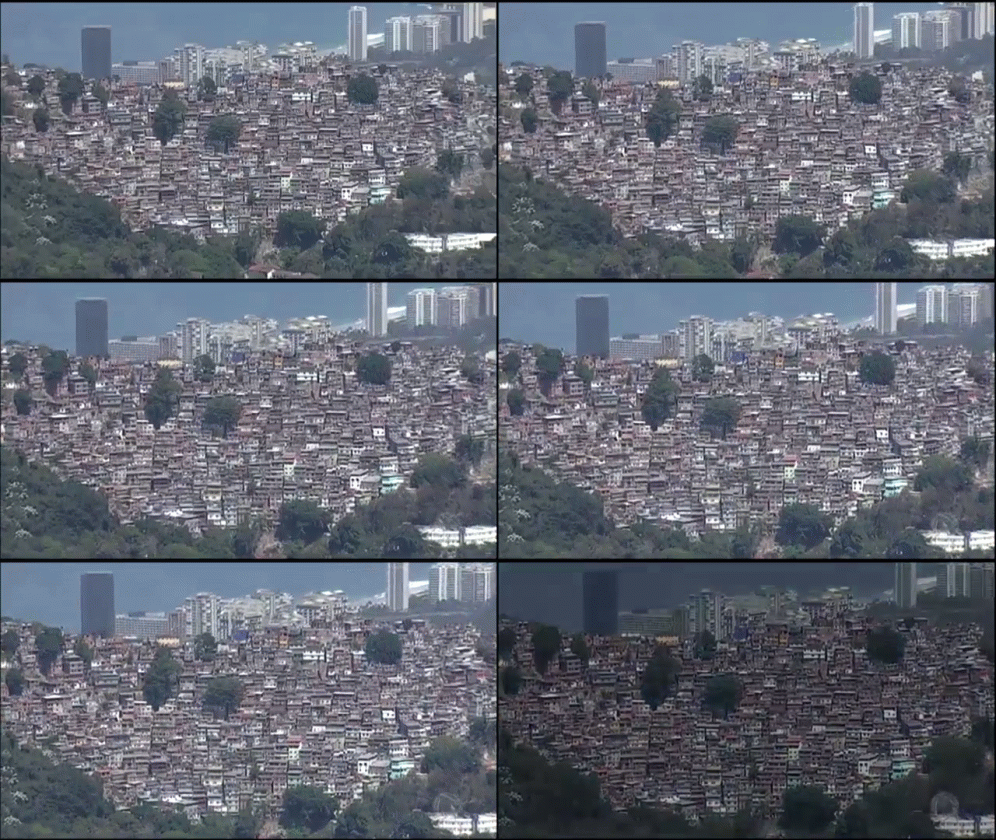
- So, what do we do with this? In my view, we need strategies to interrupt community transmission, e.g. better IPC in clinics, affordable housing close to workplaces (so people don't have long commutes on crowded public transport), case finding targeted at people in indoor congregate settings [10/n]
- Strong social gradients in TB persist We need a greater focus on social protection, both that targetted at TB affected households - to reduce catastrophic costs associated with illness and accessing TB treatment - and more generally The benefits of this would extend beyond TB [11/n]
- Clearly, recent steep cuts to TB programmes threaten progress and constrain what is possible going forward Hard to think of a more regressive funding decision than the UK Government's choice to fund increases in military spending entirely via cuts to ODA (Cc my MP @stellacreasy.bsky.social) [12/n]
- Big thanks to those who reanalysed data for us and to coauthors, especially Martha, who turned a part complete project into a paper Supplementary material not yet uploaded to SSRN - trying to fix this, but message me directly if you want a copy I'll upload code/data to GitHub on Monday [13/13]


